
Your wedding day will pass in a blur of rituals, conversations, hugs, laughter, photographs, and moments you may not even realise are happening. Years later, however, your photographs will be one of the few things that can take you back to that day.
That makes choosing between candid vs traditional wedding photography more than a question of photographic style. It is about deciding how you want your wedding memories to look and feel when you revisit them years from now.
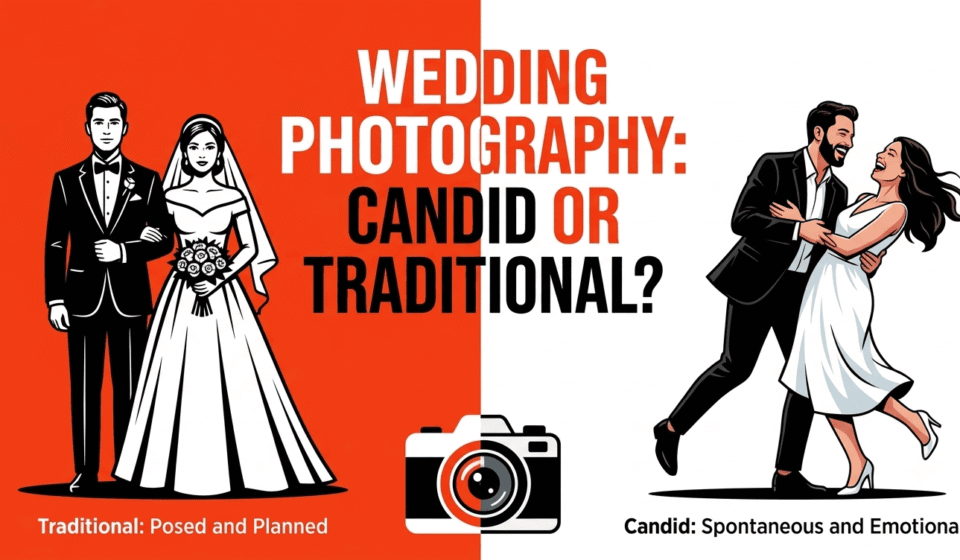
Candid wedding photography focuses on natural expressions, spontaneous interactions, and moments that unfold without obvious posing. Traditional wedding photography, on the other hand, places greater emphasis on planned group photographs, family portraits, rituals, and carefully arranged compositions.
Neither approach is automatically right for every couple. Your choice depends on your personality, wedding format, family expectations, priorities, and the kind of album you want to create.
In many cases, the most practical answer is not choosing one over the other. A thoughtful combination of both can document the wedding comprehensively while preserving its emotional character.
Candid vs Traditional Wedding Photography: What Is the Difference?
The simplest distinction is this:
Candid wedding photography captures moments as they naturally happen, while traditional wedding photography focuses more on posed, planned, and formally composed photographs.
That difference affects how the photographer works throughout the event.
|
Feature |
Candid Wedding Photography |
Traditional Wedding Photography |
|
Approach |
Natural and spontaneous |
Posed and planned |
|
Expressions |
Unscripted |
Directed |
|
Group photos |
Usually secondary |
Major focus |
|
Wedding rituals |
Captured as they unfold |
Often photographed from planned angles |
|
Couple portraits |
Relaxed and movement-based |
More structured |
|
Family documentation |
Often candid |
Formal and comprehensive |
|
Best for |
Emotion and storytelling |
Completeness and formal records |
|
Photographer involvement |
Often less obvious |
More direct |
For example, a candid photographer may photograph a bride laughing with her friends before the ceremony without asking anyone to pose. A traditional photographer may arrange the bride, parents, siblings, and relatives for a formal portrait after the ceremony.
Both photographs have value. One preserves the feeling of the moment; the other records exactly who was there.
What Is Candid Wedding Photography?
Candid wedding photography is centred on photographing genuine moments rather than creating every photograph through instructions and poses.
The photographer observes what is happening and looks for expressions, interactions, gestures, movement, and small details that tell the story of the day.
These might include:
- A parent becoming emotional during the ceremony
- Friends laughing while getting ready
- A couple exchanging an unplanned glance
- Children playing during the reception
- Guests reacting to a speech
- A quiet moment between the couple after the ceremony
- Someone wiping away a tear before anyone notices
The strongest candid photographs often work because the people in them were not thinking about the camera.
Why Do Couples Choose Candid Photography?
Candid photography appeals to couples who want their wedding album to feel like a visual story rather than a collection of arranged portraits.
It can capture personality particularly well. Instead of asking you to recreate an emotion, the photographer waits for that emotion to happen naturally.
This can also make the experience more comfortable for people who do not enjoy posing.
However, candid does not mean random.
A skilled candid photographer still needs to understand composition, lighting, timing, backgrounds, camera settings, and human behaviour. The photograph may look effortless, but creating it often requires considerable observation and technical judgment.
What Is Traditional Wedding Photography?
Traditional wedding photography is built around planned compositions and posed photographs.
The photographer usually directs people into specific positions, checks the composition, and captures the photograph once everyone is ready.
This style is particularly useful for documenting people and ceremonies systematically.
Typical traditional wedding photographs include:
- Bride and groom portraits
- Couple with parents
- Immediate family portraits
- Extended family photographs
- Wedding party photographs
- Important rituals
- Formal portraits with guests
- Group photographs after the ceremony
Traditional photography has an important advantage: it makes it less likely that important people or formal moments will be missed.
A candid photograph of your parents laughing together may be beautiful. But you may still want one clear photograph of you, your partner, and both sets of parents standing together.
That photograph may become one of the most meaningful images in your family collection.
Candid vs Traditional Wedding Photography: Which Style Gives Better Memories?
There is no universal winner because the two styles preserve different kinds of memories.
Think about looking through your wedding album twenty years from now.
You may want to remember what your reception looked like, but you may also want to see your grandmother’s expression during the ceremony. You may want a beautiful portrait of yourself in your wedding outfit, but you may also want to remember how your friends reacted when they first saw you.
This is why wedding photography works best when it documents both people and moments.
Candid photographs often answer:
“What did it feel like?”
Traditional photographs often answer:
“Who was there, and what did we look like?”
A complete wedding gallery can benefit from both.
When Should You Choose Candid Wedding Photography?
Candid photography may suit you particularly well if you want an emotional, natural, documentary-style wedding album.
Consider prioritising candid coverage if:
You dislike posing
Some people become visibly uncomfortable as soon as a camera points at them.
If you would rather talk, move, laugh, and interact naturally, candid photography can reduce the pressure to perform for the camera.
You care about emotions and interactions
If your favourite photographs are likely to be the ones showing genuine laughter, tears, excitement, affection, and reactions, candid photography deserves a significant place in your wedding plans.
You want a storytelling-style album
Candid images can help connect different parts of the wedding day.
Getting-ready photographs can establish the beginning. Ceremony moments can build the emotional centre. Couple portraits and reception photographs can bring the story toward its conclusion.
Your wedding is informal or intimate
Smaller weddings often have a relaxed flow, which can create excellent opportunities for natural photographs.
An intimate celebration may not require hundreds of formal group combinations, making a documentary approach particularly suitable.
When Is Traditional Wedding Photography a Better Fit?
Traditional photography can be especially important when your priority is complete documentation.
You have a large family
Large weddings can involve dozens of combinations of parents, siblings, grandparents, cousins, friends, and colleagues.
Without some planning, it is easy to discover after the wedding that you have no proper photograph with a particular relative.
A traditional photography session gives the photographer a system for working through important combinations.
Family portraits matter to you
For many couples, formal family photographs are not optional.
They become framed photographs, anniversary memories, gifts for parents, or records that future generations will appreciate.
Your wedding includes important rituals
Traditional coverage can provide deliberate documentation of significant ceremonial moments.
The photographer can anticipate important parts of the ceremony and make sure the necessary photographs are taken.
You want classic portraits
If you imagine your wedding album containing elegant portraits with carefully arranged compositions, traditional photography may be an important part of your coverage.
Is Candid Photography Better Than Traditional Photography?
The better question is: better for what?
Candid wedding photography is better suited to couples who prioritise spontaneous emotions and natural storytelling.
Traditional wedding photography is better suited to couples who prioritise formal portraits, family documentation, and structured coverage.
Neither style should be judged only by whether photographs look modern or classic.
A technically excellent candid photograph can still be unimportant if it misses the people you wanted documented. Similarly, a beautifully composed traditional portrait may have enormous sentimental value even though it is posed.
The quality of the photographer’s observation, communication, technical ability, and understanding of your priorities matters as much as the style itself.
Why Combining Candid and Traditional Photography Often Makes Sense
For many weddings, the choice does not have to be either-or.
A hybrid approach can divide the day according to what each style does best.
For example:
Getting ready: Primarily candid
Family portraits: Traditional
Ceremony: Combination of both
Couple portraits: Candid with some direction
Group photographs: Traditional
Reception: Primarily candid
This approach provides structure where structure is useful and freedom where natural moments matter more.
It also solves one of the biggest practical problems in wedding photography: trying to make every photograph follow the same visual formula.
Candid vs Posed Wedding Photos: What Should You Ask For?
Before booking a photographer, look beyond their portfolio’s most attractive images.
Ask to see a complete wedding gallery.
A portfolio may contain twenty exceptional photographs selected from several weddings. That does not necessarily tell you how the photographer handles an entire event.
A full gallery can show you:
- How they photograph indoor ceremonies
- Whether family photographs are well organised
- How they handle difficult lighting
- Whether skin tones look natural
- How they photograph crowded spaces
- Whether important rituals are documented
- How consistent their editing is
- Whether photographs remain sharp during movement
- How they capture ordinary moments between major events
This is one of the most useful ways to evaluate wedding photography.
How to Choose the Right Wedding Photography Style for Your Personality
Your personality should influence your decision more than photography trends.
Ask yourself these questions:
Do you enjoy being photographed?
If you naturally enjoy posing and interacting with a camera, traditional portraits may feel easy.
If you become self-conscious around cameras, a candid approach may feel more natural.
What photographs do you save now?
Look at photographs you already love.
Do you gravitate toward portraits where everyone is looking at the camera? Or do you prefer photographs where people are laughing, moving, talking, or unaware of the photographer?
Your existing preferences can reveal more than a photography trend on social media.
What will your family want?
Your own preferences matter, but wedding photography often involves several generations.
If your parents or grandparents strongly value formal family photographs, make sure your photography plan includes dedicated time for them.
What do you want your album to communicate?
If you want the album to feel like a movie of the day, candid photography may play a larger role.
If you want it to resemble a beautifully organised family record, traditional photography may be more prominent.
How Much Time Should You Set Aside for Wedding Photography?
Photography needs time, even when you want a candid wedding.
This is an important point couples sometimes overlook.
Candid photography may look spontaneous, but the photographer still needs opportunities to observe and work. Traditional portraits require even more deliberate scheduling.
Create a realistic photography timeline that accounts for:
- Getting-ready coverage
- Couple portraits
- Family portraits
- Wedding party photographs
- Ceremony coverage
- Reception photographs
- Travel between locations
- Important rituals
- Sunset or outdoor portraits, if desired
If you schedule every minute of the wedding without breathing room, the photography experience can become stressful.
A small amount of buffer time can make a substantial difference.
How to Get Natural Couple Photos Without Feeling Posed
You do not need to choose completely candid photography to get natural-looking couple portraits.
A photographer can use gentle direction rather than rigid posing.
Instead of saying, “Stand here and smile,” they might ask you to walk together, talk to each other, look at one another, adjust an outfit, or simply spend a moment together.
This produces movement and interaction while still allowing the photographer to control composition and lighting.
For couples who feel awkward in front of a camera, this middle ground can be particularly effective.
Questions to Ask Before Booking a Wedding Photographer
The photographer you choose will influence the experience as much as the final photographs.
Before signing a contract, ask:
1. What photography style do you primarily follow?
Ask whether the photographer describes their work as candid, traditional, documentary, editorial, fine art, or a combination.
Terms can mean different things to different photographers, so ask for examples.
2. Can we see a complete wedding gallery?
This should be one of your most important questions.
3. How do you handle family photographs?
Find out whether they help organise combinations or expect the couple to manage everyone.
4. How much direction do you give during couple portraits?
This can help you understand whether the experience will feel highly posed or more relaxed.
5. How do you approach important ceremonies and rituals?
Ask how they ensure significant moments are covered without disrupting the event.
6. What is included in the wedding photography package?
Check the number of photographers, hours of coverage, edited photographs, albums, prints, engagement sessions, delivery format, and any other included services.
Do not assume that two packages with similar prices provide identical coverage.
What About Wedding Photography Cost?
Wedding photography prices vary substantially depending on location, photographer experience, coverage duration, number of photographers, deliverables, editing, album specifications, and other services.
The cheapest package is not necessarily the most economical choice if it leaves out coverage you consider important.
Likewise, a more expensive package is not automatically better for your needs.
Instead, compare packages based on what you actually need documented.
For example, a couple planning a short ceremony may not need extensive full-day coverage. A large multi-event wedding may need multiple photographers and longer coverage to document everything properly.
Ask for the complete cost and deliverables in writing before making a decision.
Common Mistakes Couples Make When Choosing Wedding Photography
Choosing based only on Instagram
A photographer’s strongest social media images may not represent an entire wedding gallery.
Look for consistency.
Booking without discussing priorities
Tell your photographer which people, rituals, details, and moments matter most to you.
Do not assume they will automatically know.
Forgetting family photographs
Candid coverage can be beautiful, but it should not accidentally replace photographs you know your family will want.
Creating an unrealistic timeline
Photography requires time. Rushing through every portrait can affect both the experience and the final images.
Copying another couple’s shot list exactly
A shot list can be useful, but your wedding is not someone else’s wedding.
Use examples for inspiration and identify the photographs that genuinely matter to you.
Treating editing style as an afterthought
Photographers can have dramatically different approaches to colour, contrast, skin tones, shadows, and overall mood.
Look at full galleries, not just individual photographs.
A Simple Way to Decide Between Candid and Traditional Photography
If you are still undecided, use this five-step process.
Step 1: List your non-negotiable photographs.
Write down the people, rituals, portraits, and moments you absolutely want documented.
Step 2: Identify your preferred visual style.
Collect ten to fifteen wedding photographs you genuinely like and look for patterns.
Step 3: Consider your guest list.
A 30-person intimate ceremony has different photography needs from a 500-person celebration.
Step 4: Review complete galleries.
Compare how different photographers document an entire wedding rather than isolated highlights.
Step 5: Build a balanced photography plan.
Use traditional photography for photographs that require organisation and candid photography for moments that benefit from freedom.
This approach makes the decision more practical and less dependent on trends.
Candid vs Traditional Wedding Photography: Which One Should You Choose?
When deciding between candid vs traditional wedding photography, start with the memories you want to preserve rather than the style currently receiving attention online.
Choose a stronger candid focus if you want spontaneous expressions, emotional interactions, and a natural storytelling approach. Give traditional photography greater importance if formal portraits, family combinations, and systematic documentation are high priorities.
For many couples, combining both approaches offers the most complete record of the wedding. You can have a carefully composed photograph with your parents and an unplanned photograph of everyone laughing five minutes later.
Those photographs serve different purposes, and that is precisely why both can belong in the same wedding album.
The right wedding photography style is ultimately the one that reflects how you want to remember the day: not simply how you want it to look on the wedding day itself, but how you want those memories to feel decades later.
Frequently Asked Questions
- Can candid and traditional wedding photography be included in the same package?
Yes. Many wedding photography plans can combine candid coverage with traditional portraits. This allows couples to document spontaneous moments while also ensuring important family combinations, group photographs, and formal portraits are captured.
- Is candid wedding photography suitable for large weddings?
Yes, but large weddings require careful planning. Candid photography can capture the energy and interactions of a large celebration, while a structured family-photo plan helps ensure important people are not missed.
- How many traditional wedding photographs should a couple plan for?
There is no universal number. The required combinations depend on the size of the family and wedding party. Creating a priority list of essential group photographs can help keep formal photography organised without consuming excessive event time.
- Should couples give their photographer a shot list?
A short priority shot list can be useful, particularly for family combinations and important details. Avoid creating an excessively rigid list of every candid moment you expect, because natural photographs depend on what actually happens during the celebration.
- What should I look for when comparing wedding photography packages?
Compare coverage hours, number of photographers, edited photographs, albums, prints, engagement sessions, delivery method, editing style, and any additional services. Most importantly, review complete galleries to understand what the photographer consistently delivers.