

Nobody feels confident the second a camera points at them. Your hands go stiff. Your smile stops looking like your smile. And somehow you forget how you normally stand next to your own partner.
If that sounds familiar, take a breath. Every couple deals with this at some point.
Great couple photos rarely come from perfect posing. They come from small, comfortable movements and real moments between two people. This guide walks through simple ways to look relaxed, what to do with your hands, and 20 couple poses you can actually use, whether you’re planning engagement pictures, wedding portraits, or just a fun photo session with your partner.
What Makes a Couple Pose Look Natural?
Natural posing has almost nothing to do with holding a perfect position. It’s about starting from a relaxed stance and letting small adjustments happen from there.
Here’s what actually helps:
- Let your shoulders fall down and back instead of tensing them up.
- Get close enough to your partner that your bodies actually touch somewhere, a hand, a shoulder, a hip.
- Turn slightly instead of squaring off straight toward the lens.
- Spend some of the shoot looking at your partner instead of the camera.
- Loosen your hands. Clenched fingers show up in photos more than people expect.
- Add small movement. Sway a little. Shift your weight. Take a step forward.
- Keep the conversation going instead of freezing your expression between shots.
A photo with a little motion almost always beats a frozen one. Stillness reads as tense on camera, even when you don’t feel tense in real life.
Photographers often ask couples to walk, turn toward each other, or say something funny. That’s not busywork. It gives your body something to do so your face stops thinking about the camera.
You’re also not responsible for getting every detail right. Let your photographer worry about angles and lighting. Your only job is paying attention to the person standing next to you.
What Should You Do With Your Hands?
Ask any couple what feels worst during a photo session and hands usually come up first. The fix is simple. Give your hands a reason to be somewhere.
Try holding hands, resting a palm against your partner’s chest, or slipping your own hands into your pockets. An arm around the waist works. So does adjusting a jacket collar or gently holding your partner’s face for a close shot.
A small prop can help too. Think a coffee cup, a bouquet, sunglasses, or anything else that gives restless hands a purpose.
The trick is not overthinking it. The moment you start arranging every finger, the pose stops looking real. Loose, natural contact beats a carefully placed hand almost every time.
Still stuck? Just say so. A photographer can fix awkward hand placement with one quick suggestion.
20 Couple Poses Worth Trying
These poses cover standing, walking, sitting, playful moments, and wedding day shots. Treat them as starting points rather than rules.
Standing together
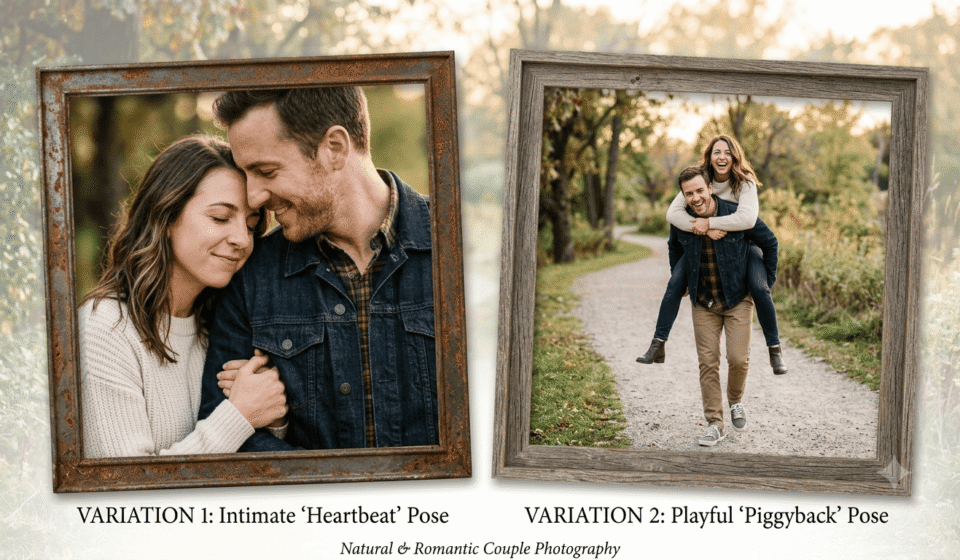
- Foreheads touching, eyes closed
- One partner wrapped in a hug from behind
- Standing close, noses nearly touching
- Back to back
- Head resting on a partner’s shoulder
On the move
- Walking hand in hand toward the camera
- Walking away together, hands linked
- One partner tugging the other forward, both laughing
- Walking side by side, mid-conversation
Sitting down
- Sitting close, legs overlapping slightly
- Head resting in a partner’s lap
- Sitting back to back on the ground
- Facing each other on a bench
Getting playful
- A slow spin together
- A piggyback ride
- Whispering something ridiculous
- A quick kiss on the cheek
For wedding days
- The embrace right after a first look
- A slow dance with no music playing
- Walking away together in full wedding attire
None of these poses need to look staged. Add a real joke, a shared memory, or an inside comment, and the photo usually turns out better than any planned expression could.
How Do You Stop Looking Stiff in Photos?
Most awkward photos come from one thing. Staring directly into the lens and holding a smile way too long.
Give your eyes somewhere else to land. Your partner’s eyes, their hands, their forehead, anywhere but the camera. Keep talking between shots instead of freezing mid smile. Laugh at something that’s actually funny instead of forcing a fake one.
Movement matters here too. A slow walk, a small sway, even a quick spin gives your photographer several real moments instead of one tense frame.
Not every photo needs a huge grin either. A soft smile, a thoughtful look, or genuine laughter all work well. Variety usually makes the whole gallery feel more real.
Worried about a height difference?
Don’t be. A taller partner can rest their chin near the shorter partner’s head. The shorter partner can tuck comfortably under an arm. Sitting together, walking side by side, or using stairs can also balance things out nicely.
Worried about body type?
There’s no single pose that fits every couple, and that’s completely fine. Play with slight angles and different distances from the camera until something feels right. A good photographer will also adjust their own position to flatter both of you.
Personality matters more than technique. A calmer couple might feel most comfortable with a slow dance. A silly couple might get their best shot from a spontaneous laugh nobody planned for.
Prompts Work Better Than Pose Names
A pose tells your body where to go. A prompt gives you something to actually do. That difference changes everything about how a photo feels.
Here are prompts photographers often use:
- “Walk toward me slowly, holding hands.”
- “Whisper something that’ll make your partner laugh.”
- “Slow dance for a few seconds, even without any music.”
- “Tell your partner about your favorite memory together.”
- “Turn toward each other like you just heard something funny.”
Prompts create movement, and movement almost always leads to a more honest expression than trying to hold a specific shape.
Matching Poses to Different Photography Styles
Different photography styles call for different energy, but the same core ideas still apply underneath.
Candid photography leans on walking, talking, and letting moments happen. Romantic photography leans into closeness, think forehead touches or a quiet slow dance. Editorial photography uses sharper angles and more intentional positioning. Wedding photography usually blends all three throughout a single day.
Photographers remain one of the most booked professionals for weddings today. According to The Knot’s 2026 Real Weddings Study, which surveyed more than 10,000 U.S. couples married in 2025, 88% of couples hired a professional photographer for their wedding day.
Getting Ready Before Your Session
A bit of planning ahead makes posing much easier once the camera comes out.
Pick clothing you can actually move in. If you’re constantly fixing a collar or tugging at a hem, that discomfort shows up in the final photos.
Decide roughly what feel you’re going for. Candid, romantic, editorial, or some mix of all three.
Choose a location that means something to you both. It’s a lot easier to relax somewhere familiar than somewhere random.
And talk to your photographer beforehand. Mention if cameras make you nervous. Most experienced photographers will adjust the whole session around that.
The Bottom Line
You don’t need to memorize twenty poses to get great couple photos. You need a handful of comfortable moves, a little movement, and a real connection with your partner.
Hold hands. Walk somewhere together. Laugh at an inside joke. Whisper something silly. Let your photographer handle the technical side while you focus on the person standing right next to you.
That’s honestly most of it.
Frequently Asked Questions
How long should a couple photo session take?
It depends on the photographer and the package. Shorter mini sessions often run around thirty minutes. Full sessions, especially engagement shoots, tend to run longer once you factor in outfit changes or multiple locations.
What should couples wear for photos?
Pick colors that complement each other without matching perfectly. Solid colors usually photograph cleaner than busy patterns. More than anything, wear something comfortable enough to move around in.
What time of day gives the best couple photos?
A lot of photographers prefer golden hour, the stretch right after sunrise or before sunset, since the light tends to be soft and warm. Overcast afternoons and indoor sessions can also produce beautiful results depending on the look you want.
How do you pick the right photographer for couple or wedding photos?
Look through complete galleries instead of just a handful of favorite images. That gives a better sense of consistency. Ask about session length, turnaround time, and how many final photos are typically delivered.
Do couples need to practice poses beforehand?
Not really. Rehearsing exact poses tends to add stress rather than remove it. A few simple, movement-based ideas, like walking hand in hand or a slow dance, usually cover everything you need.
What’s the real difference between engagement photos and wedding photography?
Engagement sessions happen before the wedding and usually focus on relaxed, candid couple portraits. Wedding photography covers the entire day, including the ceremony, formal family portraits, and candid reception moments.

[…] habits. These work no matter where you take your photos or what you wear. You can also read our latest article on couple poses, which explores one of the trending photography topics in […]