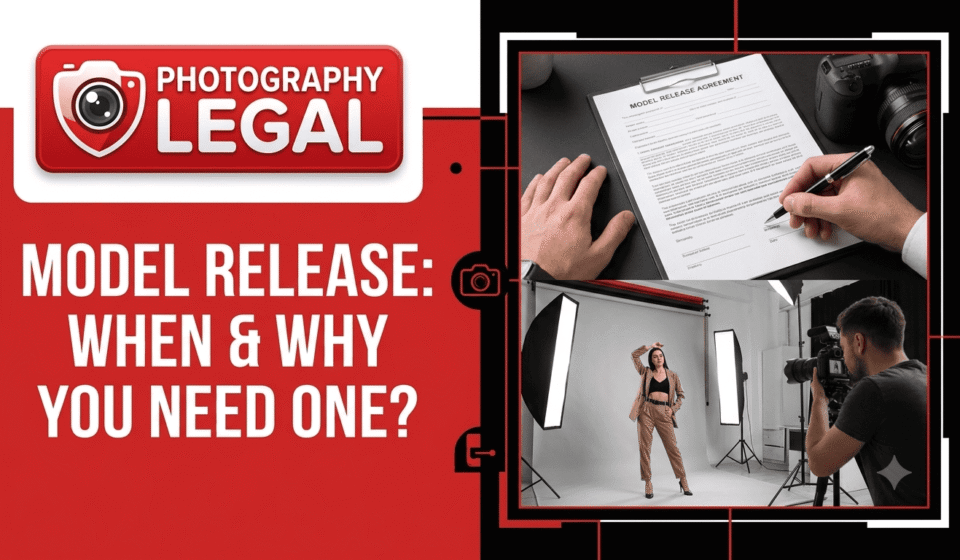

A model release is a written agreement in which a person gives permission for a photographer, creator, or other rights holder to use their recognizable likeness for specified purposes.
It is commonly used when photographs will be used commercially, such as in advertising, marketing, promotional materials, or commercial stock licensing.
A model release is an important part of planning a shoot for photographers when people can be seen. It helps keep track of permissions and can make it easier to license photos or use them for business.
However, a model release is not automatically required every time a person appears in a photograph. The answer depends on factors such as how recognizable the person is, how the photograph will be used, applicable laws, and the requirements of the platform or client.
That distinction is important. Taking a photograph and having permission to use it for a particular purpose are not always the same thing.
What Is a Model Release in Photography?
A model release is a legal agreement that gives permission to use a person’s likeness in photographs, videos, or other content for agreed purposes.
The person shown in the image is usually referred to as the model, even if they are not a professional model.
The photographer or creator typically keeps the signed release as a record of the person’s consent.
A model release may cover permission to:
- Publish photographs
- License photographs to clients or stock agencies
- Use photographs in advertising
- Use images in marketing campaigns
- Display images on websites
- Use photographs in promotional materials
- Modify or edit the images within the agreed terms
The exact rights granted depend on the wording of the release.
For example, a photographer may take a portrait for a client’s advertising campaign. The model release can document the model’s permission to use the image for that commercial purpose.
Stock platforms also have their own requirements. Adobe Stock currently requires releases for identifiable people in content submitted for licensing, while Shutterstock generally requires a valid release for each recognizable person in commercial content.
When Is a Model Release Needed?
A model release is commonly needed when a recognizable person will appear in content that is intended for commercial use.
Typical examples include:
- Advertising campaigns
- Brand marketing
- Commercial websites
- Product advertisements
- Brochures
- Promotional materials
- Commercial stock photography
- Social media advertising
- Product packaging
- Corporate marketing
The key issue is not simply whether someone appears in the photograph.
The intended use of the photograph matters too.
For example, a photographer may photograph a person walking through a public place. That photograph may be treated differently when used as editorial documentation than when the same photograph is used to advertise a company’s product.
Commercial stock platforms can have particularly specific requirements. According to Shutterstock’s current contributor guidelines, commercial content generally requires a signed model release for each recognizable person, while recognizable people in editorial content do not require model releases under Shutterstock’s submission rules.
Why Do Photographers Need a Model Release?
Photographers use model releases to document a person’s permission for specified uses of their likeness and to reduce uncertainty when an image is published or licensed.
Imagine a photographer takes a portrait of a model for a clothing company.
The company later wants to use the photograph in:
- Online advertising
- Social media campaigns
- Printed brochures
- Posters
- Website banners
A model release can document the agreed permission and help establish what uses were authorized.
This process becomes even more important when photographs are licensed to other businesses or uploaded to commercial stock platforms.
A signed release does not magically remove every legal issue surrounding an image. It is simply an important piece of documentation that clarifies consent and permitted use.
When a Model Release Is Usually Not Needed?
A model release is not automatically required simply because a person appears in a photograph.
There are situations where a release may not be required, but the answer depends on the intended use, applicable law, and platform rules.
For example, editorial photography can be treated differently from commercial photography.
Some stock platforms allow recognizable people in editorial content without a model release. Shutterstock, for example, states that recognizable people depicted in editorial content do not require model releases under its contributor standards.
Other situations may involve people who are not identifiable.
Adobe Stock says a model release is not required for crowds where individual people are not identifiable or for back views of people with no recognizable features.
Still, these examples should not be treated as universal legal rules. A photographer should consider the laws and requirements that apply to the specific use.
What Is the Difference between Commercial and Editorial Photography?
Commercial photography is generally created to promote, advertise, sell, or support a product, service, business, or brand. Editorial photography is generally used to inform, document, or comment on events and subjects rather than directly promote a product or service.
This distinction is especially important when discussing model releases.
Commercial photography
Commercial uses can include:
- Advertisements
- Brand campaigns
- Product promotions
- Corporate marketing
- Website advertising
- Brochures
- Commercial stock images
A recognizable person in commercial content commonly requires documented permission, and stock agencies may specifically require a model release.
Editorial photography
Editorial photography can include:
- News stories
- Documentary photography
- Current events
- Public events
- Editorial articles
- News-related publications
Editorial rules can differ from commercial rules.
For example, Shutterstock states that editorial content may contain recognizable people without model releases, while commercial content generally requires releases for recognizable people.
The important point is that the same photograph may be treated differently depending on how it is used.
Do You Need a Model Release for Street Photography?
Not necessarily. A model release is not automatically required for every street photograph, but the intended use and applicable law matter.
A street photographer may photograph people in a public place as part of documentary or editorial work.
That does not automatically mean the photograph can be used for every commercial purpose.
For example, using a street photograph in a news article is different from using the same photograph in an advertisement for a clothing brand.
The safest approach is to consider the intended use before publishing or licensing the photograph.
If a recognizable person is going to be used to promote a product, service, or business, obtaining appropriate permission is much more important than simply relying on the fact that the photograph was taken in public.
Do You Need a Model Release If the Person’s Face Is Not Visible?
Not always, but a hidden face does not automatically mean that a model release is unnecessary.
A person may still be recognizable from other features.
These can include:
- Tattoos
- Clothing
- Distinctive body features
- Voice
- Hairstyle
- Unique surroundings
- Other identifying characteristics
Adobe Stock specifically states that a model release may be required even when a person’s face is not visible if the individual can be recognized through other details.
Shutterstock similarly includes identifiable attributes beyond a fully visible face in its release requirements.
This is an important point for photographers who shoot close-ups of hands, bodies, silhouettes, or other partial views.
What about People in the Background?
A background person may still require a model release if they are recognizable and the content is being submitted or used in a context that requires one.
This is another area where photographers sometimes make assumptions.
A person does not have to be the main subject of the photograph to be identifiable.
For example, imagine a lifestyle photograph showing one person in sharp focus with another recognizable person walking behind them.
Depending on the intended use and platform requirements, the background person may also need a release.
Shutterstock’s current contributor guidance requires a release for each recognizable person in commercial content. Adobe Stock also specifically lists people in the background or passing through the frame among situations where a release may be required.
What Does a Model Release Form Include?
A model release form normally records the identity of the model, the creator or photographer, the consent being given, relevant dates, and signatures.
The exact contents depend on the form and its intended use.
A model release may include:
- Model’s name
- Photographer’s or creator’s name
- Contact information
- Date of the agreement
- Description or identification of the photographs
- Permission to use the person’s likeness
- Permitted uses
- Model’s signature
- Photographer’s signature
- Witness information, where required
- Parent or guardian information for minors, where applicable
The form should be completed accurately and legibly.
This matters particularly when submitting photographs to stock agencies.
Shutterstock states that its releases must be accurate and legible, and Adobe Stock similarly advises contributors to make sure releases are complete, signed, and dated.
Do You Need a Separate Model Release for Each Person?
For many commercial stock workflows, each recognizable person needs their own model release.
For example, if a photograph shows three recognizable people, a stock agency may require three separate releases.
Shutterstock currently states that a separate model release is required for each recognizable person in submitted commercial content. Adobe Stock’s current requirements also state that contributors must submit a release for each person in the content.
The exact document format can differ by platform.
This is one reason photographers should check the requirements of the stock agency or client before a shoot rather than assuming that one form will work everywhere.
Do You Need a Model Release for a Minor?
Commercial use involving a minor may require a parent or legal guardian to sign the model release.
Children and teenagers require extra care because they cannot always provide consent in the same way as an adult.
Stock platforms have specific rules for minors.
Adobe Stock currently states that if the model was under 18 at the time the content was created and is still under 18, a parent or legal guardian must sign the release.
Shutterstock also has separate requirements for minor model releases.
For any commercial project involving children, the photographer should check the applicable legal requirements and the client’s or platform’s documentation rules before the shoot.
Do You Need a Model Release for a Self-Portrait?
A self-portrait can still require a model release when it is submitted to a stock platform that requires one for recognizable people.
This may sound strange because the photographer and the person in the photograph are the same person.
However, stock platforms may still require the contributor to document consent.
Shutterstock requires a model release for self-portraits and says the contributor must complete the form as both the model and the photographer or account holder.
Adobe Stock also lists self-portraits among content that requires a model release under its current contributor requirements.
So, if a photographer plans to submit self-portraits to a stock agency, the agency’s specific rules should be checked first.
Is a Model Release the Same as Copyright?
No. Copyright and a model release deal with different rights.
Copyright generally concerns rights in the photograph as a creative work.
A model release deals with permission connected to the person’s likeness and the agreed use of the image.
For example, a photographer may own copyright in a portrait they created. That does not automatically mean every possible commercial use of the person’s likeness is covered.
This is why photographers should understand the difference between:
Copyright: Who owns or controls rights in the creative work?
Model release: What permission has been given regarding the person’s likeness and use of the image?
Other rights can also be relevant, including privacy, publicity, trademark, and property rights, depending on the image and how it will be used.
What Is the Difference Between a Model Release and a Property Release?
A model release concerns a recognizable person, while a property release concerns certain recognizable private property, artwork, or other protected property.
The two documents solve different problems.
For example, a photograph may show:
- A recognizable model
- A distinctive private interior
- Artwork
- A recognizable building or property
The person may require a model release, while the property may require a property release depending on the intended use and applicable requirements.
Adobe Stock, for example, distinguishes model releases from property releases and has separate requirements for recognizable private property, artwork, and distinctive objects.
Can a Model Release Be Signed Digitally?
Yes, digital model releases can be accepted in some photography workflows and by some stock platforms, but the exact requirements vary.
Adobe Stock currently supports digital signatures through Adobe Acrobat Sign and also accepts certain existing signed releases that meet its requirements.
Shutterstock also accepts certain digital releases, including releases created through its accepted Easy Release workflow.
The important point is not simply whether a release is digital.
It must meet the requirements of the client, stock agency, or applicable process.
A photographer should therefore check the platform’s current rules before relying on a particular electronic release method.
How Should Photographers Handle Model Releases?
The easiest approach is to handle the model release before the shoot whenever the intended use requires documented consent.
A simple workflow looks like this:
1. Decide How the Photos Will Be Used
Think about the final purpose before taking the photographs.
Will they be used for:
- Advertising?
- A company website?
- Social media marketing?
- Commercial stock?
- Editorial publication?
- A personal portfolio?
The answer can affect the documentation required.
2. Explain the Intended Use
The person signing the release should understand what they are agreeing to.
The release should clearly communicate the permitted use according to the form or agreement being used.
3. Complete the Release
Fill in the required information accurately.
Avoid leaving important fields blank.
4. Get the Required Signatures
Make sure all required parties sign and date the document.
For minors, follow the applicable parent or legal guardian requirements.
5. Keep the Release Secure
Store the completed release somewhere it can be found later.
This becomes particularly important when a photographer licenses photographs months or years after the original shoot.
6. Match Releases to the Correct Images
A photographer working with multiple models should maintain clear records.
This makes it easier to identify which release belongs to which person and shoot.
What Are Common Model Release Mistakes?
Even a simple release can become a problem if it is handled carelessly.
Assuming Every Photograph Needs a Release
Not every photograph showing a person automatically requires a model release.
The intended use, recognizability, jurisdiction, and platform rules all matter.
Assuming a Public Place Means Anything Is Allowed
Taking a photograph in a public place does not automatically answer every question about how that image can later be used.
Commercial advertising and editorial documentation can be treated differently.
Ignoring Background People
A recognizable person in the background can still matter.
This is especially important for commercial stock submissions.
Assuming a Hidden Face Solves Everything
A person can sometimes be identified without a fully visible face.
Tattoos, clothing, body features, voice, and other details can matter.
Using an Incomplete Form
Missing names, signatures, dates, or other required information can create problems during licensing or stock submission.
Forgetting Platform Requirements
A release that works for one client or platform may not meet another platform’s specific requirements.
Always check the current submission rules before uploading commercial content.
Model Release Example: When Would a Photographer Need One?
Consider a photographer hired by a fitness company.
The photographer takes photographs of a recognizable athlete using the company’s equipment.
The company wants to use those photographs in online advertisements.
This is clearly a commercial context involving a recognizable person.
A model release would therefore be an important part of the shoot documentation.
Now consider a photographer covering a public sporting event for a news article.
The photographs are being used to document the event rather than advertise a product.
The situation can be different because editorial use may have different rules. Shutterstock, for example, does not generally require model releases for recognizable people in editorial content under its contributor standards.
These examples show why the question is not simply:
“Is there a person in the photograph?”
The better question is:
“Who is recognizable, how will the photograph be used, and what rules apply to that use?”
Why Model Releases Matter for Stock Photography
Stock photography is one of the clearest situations where model releases become important.
Stock agencies need to know that photographs containing recognizable people can be licensed for the uses offered by the platform.
Adobe Stock currently requires signed releases for identifiable people in content submitted for licensing. Its guidance also covers less obvious cases, including recognizable body parts, people in the background, self-portraits, and identifiable individuals whose faces are not visible.
Shutterstock similarly requires releases for recognizable people in commercial submissions and has specific requirements for self-portraits, minors, and individual release files.
This makes release management an important part of a stock photographer’s workflow.
A Simple Model Release Checklist for Photographers
Before a commercial shoot involving recognizable people, check the following:
- Is the person recognizable?
- How will the photographs be used?
- Is the use commercial or editorial?
- Does the client require a model release?
- Does the stock platform require one?
- Has the correct release form been selected?
- Are all required fields completed?
- Has the model signed and dated it?
- Is a parent or guardian required?
- Is the release stored securely?
- Can the release be matched to the correct photographs?
This small checklist can prevent a lot of confusion later.
The Bottom Line
A model release is a written record of a person’s permission for specified uses of their likeness, and it is especially important when recognizable people appear in commercial photography.
The need for a release depends on more than whether someone appears in the frame. The intended use, how recognizable the person is, applicable laws, and the requirements of a client or platform all matter.
For photographers, the safest workflow is simple: decide how the images will be used, identify whether releases are needed, obtain the appropriate consent, complete the paperwork correctly, and keep the records organized.
That preparation may take only a few minutes during a shoot, but it can make the licensing and publishing process much smoother later.
Most importantly, a model release should not be treated as just another form to sign. It is a way of clearly documenting permission and setting expectations about how a person’s likeness may be used.
Frequently Asked Questions
What is a model release?
A model release is a written agreement that gives permission to use a person’s likeness in photographs or other content for specified purposes. It is commonly used for commercial photography, advertising, marketing, and stock licensing involving recognizable people.
When is a model release needed?
A model release is commonly needed when a recognizable person’s image will be used commercially. However, the exact requirement depends on the intended use, applicable law, and the rules of the client or platform handling the photograph.
Do you need a model release for commercial photography?
Commercial photography involving a recognizable person commonly requires documented permission for commercial use. Stock agencies such as Adobe Stock and Shutterstock have specific release requirements for recognizable people in commercial content.
Do you need a model release for street photography?
Not necessarily. Street photography used for editorial or documentary purposes may be treated differently from photographs used commercially. The intended use, local law, and platform requirements should be considered before publishing or licensing the photograph.
Do you need a model release if the person’s face is not visible?
Not always, but an invisible face does not automatically eliminate the need for a release. A person may still be recognizable from tattoos, clothing, body features, voice, or other identifying details. Some stock platforms specifically require releases in these situations.
Do you need a model release for a child?
Commercial photography involving a child may require a parent or legal guardian to sign the model release. Stock platforms have specific rules for minors, so photographers should check the applicable requirements before submitting or licensing the images.
Is a model release the same as copyright?
No. A model release concerns permission relating to a person’s likeness, while copyright generally concerns rights in the photograph as a creative work. One does not automatically replace the other.