
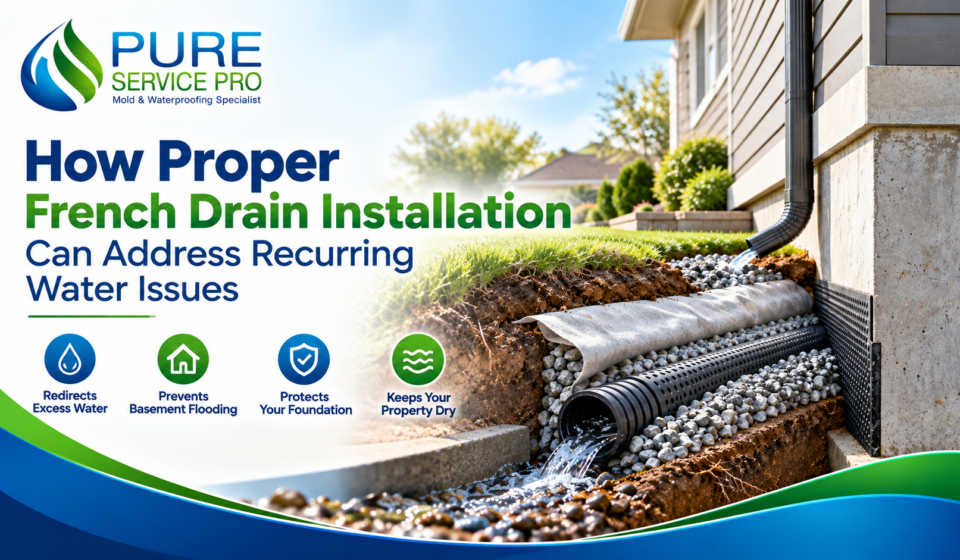

Recurring water around a home is more than an inconvenience. Persistent ground saturation can leave yards soggy, allow water to collect near the foundation, and contribute to moisture problems in basements or crawlspaces. Proper drainage can help redirect that water before it becomes a repeated concern.
For homeowners searching for Expert French Drain Installation in West Orange, understanding how these systems work can make it easier to determine whether a French drain is appropriate for the property.
What Is a French Drain?
A French drain is a drainage system designed to collect and redirect unwanted groundwater. Instead of allowing water to remain around the foundation or beneath a saturated area, the system provides a planned path for it to move away.
The right installation depends on where water is entering or collecting. Two common options include:
- Interior French drains: Installed into the basement slab to collect water entering the basement and direct it toward a sump pump.
- Exterior French drains: Installed within the landscaping to collect groundwater and reduce surface saturation around the property.
Choosing between these approaches requires looking at the property’s drainage conditions rather than simply treating visible water.
How Proper Installation Addresses Recurring Water Problems
A French drain works by giving groundwater somewhere to go. When rainwater repeatedly saturates the soil around a foundation, simply removing visible standing water may not address the underlying drainage issue.
A properly planned system can help:
- Collect excess groundwater
- Redirect water away from vulnerable areas
- Reduce ground saturation around a basement or crawlspace
- Limit water accumulation near the foundation
- Support a more effective overall drainage strategy
For example, if heavy rainfall repeatedly leaves soil saturated beside a basement, an exterior French drain may collect groundwater before it continues accumulating at the foundation. Where water is already entering the basement, an interior system can collect it and direct it to a sump pump.
Why Professional Assessment Matters
Not every water problem requires the same drainage solution. Gutters and downspouts can move roof water to the ground, but that water still needs to drain away from the house effectively. If the surrounding soil remains saturated, a French drain may be considered as part of a broader basement waterproofing approach.
A professional assessment can help identify where water is collecting, whether the issue is primarily interior or exterior, and which type of French drain is suitable.
This is also why homeowners comparing Basement Waterproofing Services in Paterson or looking for the Best Basement Waterproofing Service in West Orange should consider the property’s specific drainage conditions rather than choosing a solution based only on the visible symptom.
When Should You Consider a French Drain?
Consider having the drainage around your property evaluated if you regularly notice:
- Standing water after rainfall
- Persistent ground saturation near the foundation
- Basement water intrusion
- Moisture concerns in a crawlspace
- Water repeatedly collecting in the same area
Early evaluation can help clarify whether a French drain is appropriate and how it could fit into a property’s drainage plan.
Choose an Approach Based on the Water Problem
Effective drainage starts with understanding the source and movement of water. An appropriately designed French drain can collect groundwater and direct it toward a suitable drainage point instead of allowing it to repeatedly accumulate around vulnerable areas.
For homeowners considering Expert French Drain Installation West Orange, professional guidance can help determine whether an interior or exterior system is the better fit. The goal is not simply to move visible water, but to create a practical drainage path suited to the property’s conditions.
Frequently Asked Questions
1. How does a French drain help with recurring basement water?
An interior French drain can collect water that enters the basement and channel it toward a sump pump. This provides a controlled drainage path rather than allowing water to remain on or beneath the basement floor.
2. Is an interior or exterior French drain better?
Neither option is universally better. An interior system collects water entering the basement, while an exterior system collects groundwater around the property. The appropriate choice depends on where water is accumulating and entering.
3. Can a French drain help with saturated soil?
Yes. An exterior French drain can collect groundwater and help reduce saturation at the surface. Proper placement is important because the system needs to intercept water where it is actually accumulating.
4. Can French drains be part of basement waterproofing?
Yes. French drains can form part of a broader basement waterproofing strategy. Interior systems can collect basement water and direct it to a sump pump, while exterior systems can help manage groundwater around the structure.
5. How do I know if I need expert French drain installation in West Orange?
Repeated standing water, saturated soil near the foundation, basement water intrusion, or crawlspace moisture can justify a professional drainage assessment. An evaluation can determine whether a French drain is suitable for the property.