
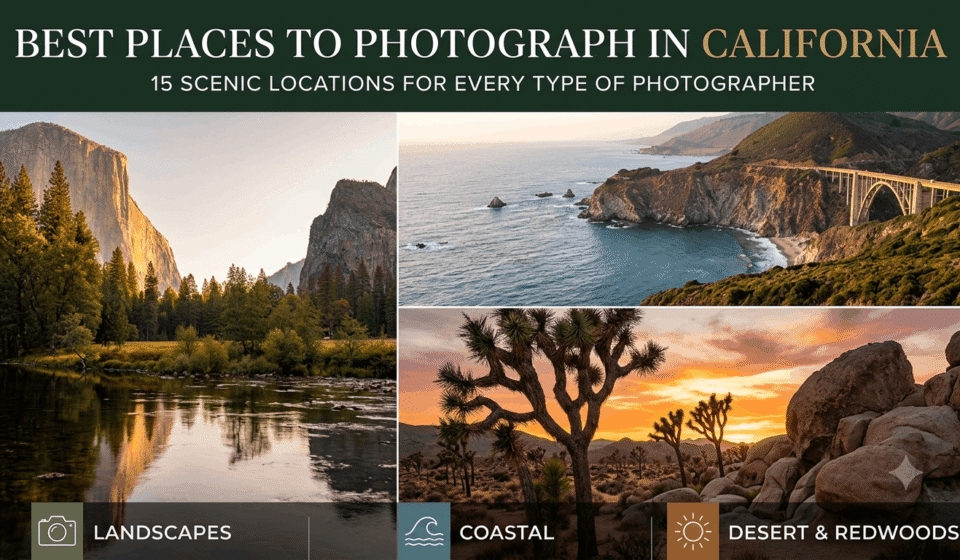
Best Places to Photograph in California: 15 Scenic Locations for Every Type of Photographer

California is one of the few places where you can photograph dramatic coastlines, granite mountains, ancient forests, deserts, waterfalls, city skylines, beaches, and alpine lakes without leaving the same state. But with so many possibilities, deciding where to point your camera first can be surprisingly difficult.
The best places to photograph in California depend on the type of images you want to create. Yosemite is ideal for monumental landscapes, Big Sur delivers rugged coastal scenery, Joshua Tree offers surreal desert compositions, while San Francisco provides instantly recognisable urban subjects. Other locations reward photographers looking for wildlife, architecture, forests, beaches, or quieter landscapes.
This guide explores some of California’s most photogenic destinations and explains what makes each one worth visiting, when to photograph it, and what type of images you can expect to capture.
What Are the Best Places to Photograph in California?
Some of the strongest photography locations in California include Yosemite National Park, Big Sur, Lake Tahoe, Joshua Tree National Park, Redwood National and State Parks, San Francisco, Death Valley National Park, the Eastern Sierra, Point Reyes, and the Southern California coast.
There is no single “best” location for every photographer. A landscape photographer may prefer Yosemite, while someone interested in architecture could find San Francisco more rewarding. The best choice depends on your subject, season, available time, and preferred shooting conditions.
Here are 15 locations worth considering for a California photography trip.
1. Yosemite National Park: Best for Iconic Mountain Landscapes
Yosemite is arguably the most recognisable landscape photography destination in California. Its combination of granite cliffs, waterfalls, forests, meadows, and rivers gives photographers an extraordinary range of subjects within a relatively concentrated area.
The most famous compositions include Half Dome, El Capitan, Yosemite Falls, and Yosemite Valley. However, concentrating only on the obvious viewpoints can make your photographs look similar to thousands of other images.
For a more distinctive portfolio, look for changing light, reflections, foreground elements, seasonal waterfalls, trees, and less obvious perspectives.
Best for:
- Landscape photography
- Waterfalls
- Mountain photography
- Sunrise and sunset images
- Winter and spring scenes
Photography tip
Arrive early when possible. Besides offering softer light, early morning can give you cleaner compositions before popular viewpoints become busy. Weather also matters: clouds, mist, snow, and changing conditions can completely transform familiar scenes.
Yosemite is consistently highlighted among leading California landscape photography guides because of the sheer variety of subjects available in the park.
2. Big Sur: Best for Coastal Photography
If dramatic ocean scenery is your priority, Big Sur should be near the top of your list.
The Central Coast combines cliffs, rocky shorelines, ocean views, bridges, forests, and winding roads. The contrast between the Pacific Ocean and rugged landforms creates strong compositions, particularly when the light is soft.
Bixby Bridge is one of the area’s best-known subjects, but it is only one part of the photographic experience. Look for coastal details, waves hitting rocks, winding roads, silhouettes, and changing atmospheric conditions.
Best for:
- Coastal landscapes
- Road-trip photography
- Ocean sunsets
- Seascapes
- Travel photography
Photography tip
Don’t rush from viewpoint to viewpoint. Big Sur is particularly rewarding when you spend time watching how the light changes across the coastline.
Also check current road, weather, parking, and access conditions before planning a photography route. Coastal conditions and road availability can affect travel plans.
3. Lake Tahoe: Best for Alpine Scenery
Lake Tahoe combines deep-blue water, mountain backdrops, pine forests, rocky shorelines, and seasonal snow. That makes it one of California’s most versatile locations for landscape photography.
Emerald Bay is an obvious favourite, particularly because Fannette Island and the surrounding mountains create layers within a single composition.
But Lake Tahoe changes dramatically throughout the year. Summer brings clear water and green forests, autumn introduces changing foliage in surrounding areas, and winter can create snow-covered mountain compositions.
Best for:
- Lake photography
- Mountain landscapes
- Winter photography
- Sunrise and sunset
- Aerial-style compositions from elevated viewpoints
Photography tip
Use foreground elements such as rocks, branches, or shoreline details to create depth rather than photographing the lake as a flat horizontal scene.
Lake Tahoe’s combination of alpine scenery and water is one reason it repeatedly appears in California photography guides.
4. Joshua Tree National Park: Best for Desert Photography
Joshua Tree offers a completely different visual language from California’s mountains and coastline.
Twisted Joshua trees, enormous boulders, desert vegetation, open horizons, and dramatic skies create opportunities for minimalist and surreal compositions.
The desert is particularly compelling around sunrise, sunset, and blue hour, when low-angle light creates long shadows and adds texture to rocks.
Best for:
- Desert landscapes
- Astrophotography
- Minimalist photography
- Sunset photography
- Creative compositions
Photography tip
Don’t limit yourself to wide-angle photographs. A telephoto lens can isolate interesting shapes, trees, rock formations, and layers across the desert.
Because desert environments can be harsh, bring sufficient water, protect your equipment from dust, and avoid relying entirely on your phone for navigation.
5. Redwood National and State Parks: Best for Forest Photography
California’s redwood country provides a photographic experience that is almost the opposite of the desert.
Instead of wide horizons, photographers work with towering trunks, dense vegetation, filtered light, moss, ferns, and winding forest roads.
The scale of the redwoods can be difficult to communicate in a photograph. Including a person at a safe and appropriate distance can help viewers understand how enormous the trees are.
Best for:
- Forest photography
- Nature photography
- Moody images
- Detail photography
- Environmental portraits
Photography tip
Overcast conditions are often useful in forests because they reduce harsh contrast. Look for shafts of light, repeating tree patterns, winding trails, and foreground foliage.
California’s redwood forests are regularly identified as standout landscape photography environments because their immense scale creates compositions that differ from conventional mountain and coastal scenes.
6. San Francisco: Best for Urban and Architectural Photography
California photography isn’t limited to wilderness.
San Francisco offers bridges, Victorian homes, steep streets, waterfronts, architecture, neighbourhoods, and skyline views. The Golden Gate Bridge is the obvious subject, but the city provides many alternatives.
The Painted Ladies, Palace of Fine Arts, Chinatown, cable cars, and neighbourhood streets can all produce distinctive images.
Best for:
- Architecture
- Street photography
- Cityscapes
- Travel photography
- Golden Gate Bridge photography
Photography tip
Look beyond famous landmarks. A photograph of a landmark becomes more personal when you use interesting foregrounds, reflections, people, weather, or unusual viewpoints.
For the Golden Gate Bridge, changing fog and cloud conditions can dramatically alter the mood. A clear afternoon and a foggy morning can make the same location look like two completely different places.
7. Death Valley National Park: Best for Minimalist Desert Landscapes
Death Valley is ideal for photographers who enjoy simplicity, scale, texture, and unusual geological patterns.
Salt flats, mountains, dunes, dry landscapes, and changing colours give the desert a distinctive visual character. Badwater Basin is particularly recognisable for its expansive salt landscape.
Best for:
- Minimalist photography
- Desert landscapes
- Sunrise
- Sunset
- Night photography
Photography tip
Think in terms of shapes and textures rather than trying to fill every part of the frame. Negative space can be one of your strongest compositional tools in desert environments.
Extreme temperatures can be a serious consideration, so plan carefully and check current conditions before heading into remote areas.
8. Point Reyes National Seashore: Best for Rugged Coastal Scenes
Point Reyes offers a different side of Northern California’s coastline. Headlands, beaches, cliffs, grasslands, fog, and wildlife create a varied photographic environment.
The landscape can feel wild and isolated, making it particularly attractive for photographers who want coastal images without relying on the most recognisable California landmarks.
Best for:
- Coastal landscapes
- Wildlife photography
- Foggy scenes
- Nature photography
- Moody travel images
Photography tip
Fog is not necessarily bad weather for photography. Along the Northern California coast, fog can simplify the background and create atmospheric images with subtle layers.
9. Mammoth Lakes and the Eastern Sierra: Best for Mountain Variety
The Eastern Sierra provides dramatic mountain scenery, alpine lakes, geological formations, and seasonal colour.
Mammoth Lakes is particularly attractive for photographers who want access to different types of landscapes within the same trip. Depending on the season, you can photograph lakes, mountain peaks, autumn colour, snow, and wild landscapes.
Best for:
- Mountain photography
- Alpine lakes
- Autumn landscapes
- Winter photography
- Road-trip photography
Photography tip
Try shooting at different elevations and focal lengths. A wide-angle lens can show the relationship between foreground and mountains, while a telephoto lens can compress distant peaks and reveal patterns that are easy to overlook.
10. Sequoia and Kings Canyon National Parks: Best for Giant Trees and Mountain Landscapes
Sequoia and Kings Canyon offer a useful combination for photographers who want both immense trees and dramatic mountain scenery.
The giant sequoias create strong vertical compositions, while higher elevations introduce granite formations, valleys, and panoramic views.
Best for:
- Forest photography
- Mountain landscapes
- Nature photography
- Detail shots
- Family and travel photography
Photography tip
In dense forests, avoid photographing everything with the same exposure and focal length. Try close-ups of bark, roots, foliage, and patterns alongside wider images showing the scale of the trees.
11. Santa Barbara: Best for Relaxed Coastal and Architectural Photography
Santa Barbara provides a more polished coastal aesthetic. Spanish-inspired architecture, palm-lined streets, beaches, hills, and ocean views make it useful for travel, lifestyle, and architectural photography.
It can also work well for photographers who want images that combine destination appeal with human activity.
Best for:
- Travel photography
- Architecture
- Lifestyle images
- Beach photography
- Sunset photography
Photography tip
Golden hour works particularly well for architecture and coastal scenes. Instead of photographing a building straight on, experiment with shadows, arches, doorways, and surrounding landscaping.
12. La Jolla and the San Diego Coast: Best for Beaches and Ocean Wildlife
Southern California’s coastline offers another completely different photography style.
La Jolla is known for rocky shorelines, ocean views, beaches, and wildlife. The combination of water, cliffs, and changing coastal light provides opportunities throughout the day.
Best for:
- Beach photography
- Seascapes
- Wildlife
- Sunrise
- Lifestyle photography
Photography tip
Use a faster shutter speed when photographing waves or moving wildlife. For landscapes, slower shutter speeds can create a softer impression of moving water when conditions and equipment allow.
Always maintain a safe distance from wildlife and follow local viewing rules.
13. Malibu: Best for Classic Southern California Coastlines
Malibu is ideal for photographers looking for a classic California coastal aesthetic: sandy beaches, rocky formations, ocean horizons, cliffs, and warm evening light.
Its proximity to Los Angeles also makes it convenient for photographers who want to combine city and coastal photography during the same trip.
Best for:
- Beach photography
- Sunset images
- Lifestyle photography
- Coastal landscapes
- Travel content
Photography tip
Don’t automatically shoot toward the sun. Turn around during golden hour and look for the way warm light falls across cliffs, buildings, vegetation, and people.
14. Antelope Valley: Best for Seasonal Wildflower Photography
When conditions are right, Southern California’s seasonal wildflower landscapes can produce striking photographs.
Wildflower displays are highly dependent on rainfall and environmental conditions, so they should never be treated as guaranteed annual events.
Best for:
- Flower photography
- Macro photography
- Landscape photography
- Spring photography
- Colourful compositions
Photography tip
Use a low perspective to make individual flowers part of a larger landscape. A telephoto lens can also compress layers of flowers and create a dense, colourful foreground.
Be careful not to step on vegetation or enter restricted areas simply to improve a composition.
15. Morro Bay: Best for Distinctive Coastal Photography
Morro Bay stands out because of its massive volcanic landmark, coastal environment, wetlands, and surrounding landscapes.
The area can produce a wide variety of images, from broad seascapes to wildlife and atmospheric silhouettes.
Best for:
- Coastal photography
- Wildlife
- Sunset photography
- Bird photography
- Travel photography
Photography tip
Stay through the changing light after sunset. Blue hour can produce a cooler, more balanced image than the stronger colours immediately after sunset.
How to Choose the Right California Photography Location
The best photography destination isn’t necessarily the most famous one. It is the place that matches the image you want to create.
Use this simple comparison:
|
If you want to photograph… |
Consider… |
|
Granite mountains |
Yosemite |
|
Dramatic coastline |
Big Sur |
|
Alpine scenery |
Lake Tahoe |
|
Desert landscapes |
Joshua Tree or Death Valley |
|
Giant trees |
Redwood or Sequoia |
|
Architecture |
San Francisco |
|
Beaches |
Malibu, La Jolla or Santa Barbara |
|
Wildlife |
Point Reyes, La Jolla or Morro Bay |
|
Autumn landscapes |
Eastern Sierra |
|
Wildflowers |
Antelope Valley |
|
Road-trip scenes |
Big Sur and Eastern Sierra |
This approach is more useful than choosing destinations purely by popularity. A photographer interested in forests may gain more from Redwood country than from spending an entire day chasing the Golden Gate Bridge.
What Is the Best Time of Year for California Photography?
California is a year-round photography destination, but the ideal season depends on the landscape.
Spring
Spring can be excellent for waterfalls, fresh greenery, coastal scenery, and seasonal wildflowers. Mountain areas may still have snow, while desert regions can be more comfortable than during summer.
Summer
Summer is useful for alpine destinations, high-elevation landscapes, coastal photography, and longer daylight hours. However, popular destinations can be crowded.
Autumn
Autumn is particularly attractive in parts of the Eastern Sierra, where changing foliage adds colour to mountain landscapes.
Winter
Winter can transform Yosemite, Lake Tahoe, the Sierra Nevada, and other mountain areas. Snow creates completely different compositions, although road and trail conditions can change quickly.
For every season, check current weather, road conditions, park alerts, access requirements, and photography restrictions before travelling.
Final Takeaway: Finding the Best Places to Photograph in California
The best places to photograph in California are not limited to one famous viewpoint or national park. The state’s greatest photographic strength is its diversity.
You can photograph granite walls in Yosemite in the morning, a dramatic coastline in Big Sur another day, giant redwoods farther north, desert landscapes in Joshua Tree, and city architecture in San Francisco or Los Angeles.
For the most rewarding results, choose locations according to the type of photograph you want, plan around light and season, and leave enough time to explore beyond the obvious viewpoint.
The most memorable California photographs often come from the moments between the famous shots: unexpected fog along the coast, soft light through redwoods, reflections on an alpine lake, desert shadows at sunrise, or an ordinary city street transformed by evening light.
Rather than asking only where the most photographed place is, ask a better question: What kind of photograph do I want to bring home? That answer will lead you to the right California photography location.
Frequently Asked Questions
- What are the best places to photograph in California for first-time visitors?
Yosemite, Big Sur, San Francisco, Lake Tahoe, and Joshua Tree are strong choices because they offer distinctly different landscapes. Together, they provide opportunities for mountain, coastal, urban, alpine, and desert photography without limiting the trip to one visual style.
- Where can I find the best California photography locations without hiking extensively?
San Francisco, Santa Barbara, Malibu, Big Sur viewpoints, and several accessible areas around Lake Tahoe can provide excellent photographs with relatively limited walking. However, accessibility varies by location, so check current conditions and requirements before travelling.
- What is the best California destination for landscape photography?
Yosemite is one of the strongest all-round choices for landscape photography because it combines granite formations, waterfalls, forests, rivers, and changing seasonal conditions. Big Sur, Lake Tahoe, the Eastern Sierra, and Joshua Tree are excellent alternatives depending on your preferred landscape.
- What lens is best for photographing California landscapes?
A wide-angle lens is versatile for large landscapes, but it should not be your only choice. A telephoto lens is useful for isolating mountains, compressing distant layers, photographing wildlife, and finding smaller compositions within expansive scenery.
- How many days do you need for a California photography road trip?
There is no ideal number of days for the entire state. A focused regional trip can work in three to five days, while a broader photography road trip may require two weeks or more. Choosing fewer destinations and spending more time at each usually produces better photographs than rushing between locations.